
South African daisies co-opt the genes they usually use to grow root hairs and transport iron to create petals that resemble female flies – enticing males to land and pollinate the plant
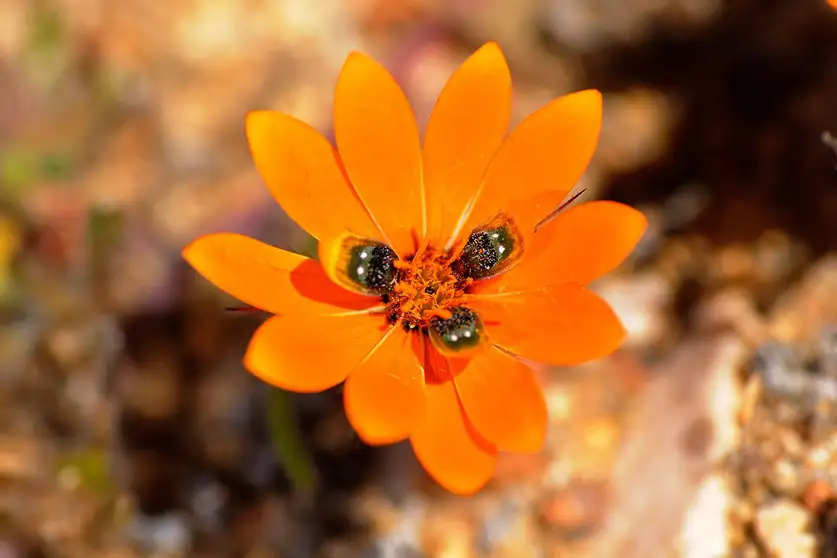
An orange-hued daisy native to South Africa has developed an intriguing strategy to attract pollinators: a tiny structure on its petals that mimics the appearance of a female fly. Male flies, tricked by this illusion, attempt to mate with the petals but end up transporting the daisy’s pollen to other plants. According to scientists, this deceptive structure evolved within a relatively short evolutionary period of 2 million years, driven by three sets of genes in the daisy that were repurposed for this purpose.
Every year, following the winter rains, South Africa’s Namaqualand desert is transformed into a vibrant sea of flowers, but this also means fierce competition for pollinators. South African daisies (Gorteria diffusa) have found a unique edge, luring bee flies (Megapalpus capensis) with their false-fly petals.
“The male fly lands directly on the spot, behaving as though it’s about to mate,” explains Beverley Glover from the University of Cambridge. In their confused efforts, these flies pick up pollen and inadvertently transfer it between plants. Glover and her team sought to identify the genes responsible for this floral trickery by comparing the gene expression in fake-fly petals to that in regular petals. Interestingly, the appearance of the fake flies varies slightly among different subpopulations of the species, typically consisting of one to four dark black dots with a raised, hair-like texture that closely mimics a female fly. Some flowers, however, don’t have the fake fly feature at all. The team also compared these daisies with other species that have simpler spots or rings without the detailed mimicry.
The researchers identified three sets of genes crucial to creating this illusion, all of which originally served different functions in the plant. “[These genes] have been co-opted or recruited to craft this remarkable fly mimic,” says Glover. “We’ve learned that this particular daisy developed these spots in the last 1.5 to 2.5 million years.” One gene set, which typically moves iron around the plant, now helps transport bluish-black pigments to the petals. Another set, responsible for creating root hairs to absorb nutrients, now gives the fake flies their hair-like texture. Finally, the genes that control the timing of flower production dictate the appearance of the fake flies on various petals.
Steve Johnson from the University of KwaZulu-Natal in South Africa, who wasn’t involved in the study, notes that this research sheds light on a key question in mimicry science—how plants can gradually evolve complex structures through the repurposing of existing genes.